
Timing at a glance
When this applies
Every MetaGrow application — through irrigation, on the berm, at transplanting, side dressed or foliar.
When to make the decision
Schedule applications shortly before important growth stages such as bud swell, fruit set, sizing and veraison. If feasible, apply to soil above 60°F; apply foliar sprays when shaded temperatures are below 90°F.
What it’s designed to support
Successful colonization, with microbes evenly distributed through the field and the soil profile.
Filter size
All MetaGrow products are filtered to 100 mesh (149 micron). Additional filtering up to 200 mesh (74 micron) is available. However, filtering to 200 mesh removes most of the beneficial fungal component, so it is not recommended unless it is necessary — for example, for subsurface drip irrigation.
Storage
Store out of direct sun and at temperatures below 120°F. Opaque tanks and white-painted totes help protect microbes from UV exposure. This applies to any microbial product.
Tank mixing with chemical fertilizers and pesticides
MetaGrow microbial products are in stasis and may be tank mixed with most fertilizers, pesticides and fungicides. All SGS microbial products that are in stasis are durable and likely compatible with most tank mixes.
Active biological products like fresh compost teas and refrigerated microbe products should not be tank mixed with any synthetic chemicals.
Fertilizer application rates
Soil microbes can be sensitive to high fertilizer application rates. Generally, do not apply more than 100 units/acre N or 80 units/acre P in a single application together with, or within a few days of, a microbial application.
It is always more effective to apply chemical fertilizers at lower rates with multiple applications rather than larger single doses.
Feeding the microbes
Microbial inputs are even more effective when applied with diverse microbial food. MetaGrow MFOOD feeds the microbes, enabling successful colonization.
| Microbe food | Rate | Use with |
|---|---|---|
| MetaGrow MFOOD | 0.1–0.25 lb per gallon of microbial product | MetaGrow microbial products |
| MetaGrow CFOOD | 0.2–2.5 lb per gallon, depending on the application objective | MetaGrow C |
- Add MFOOD to the injection tank when the tank is half full during filling, and minimize splashing to reduce or avoid foaming.
- Do not pre-mix microbes and MFOOD or CFOOD more than 24 hours before application, to avoid activating the microbes.
Application methods
MetaGrow microbe products can be applied by any application method:
- Injected through irrigation systems
- Transplant dip
- In transplant water
- Furrow run
- Sprayed on the berm
- Side dressed
- Foliar sprayed
Soil applications
- Soil temperatureSoil temperatures below 60°F result in slower microbe metabolism, so apply at warmer temperatures if feasible. Microbes will still successfully colonize at cooler temperatures — they just work slower.
- Growth-stage timingBest results are obtained by applying shortly before important plant growth stages, such as bud swell, fruit set, sizing and veraison.
- Through irrigationInject product in the middle part of an irrigation set for more even distribution through the field and through the soil profile.
- Berm spraysWhen spraying microbe solutions on a berm, it is best to irrigate within 4 hours to push the microbes into the soil.
Foliar applications
- TemperatureApply when shaded temperatures are below 90°F.
- DilutionDilute with 4 gallons of water per gallon of product, or more water as needed for good spray coverage.
- Always feedWhen foliarly applying any microbial product, it is essential to feed the microbes for successful colonization and to wake up microbes in stasis. Feed foliar microbe applications with MetaGrow MFOOD or CFOOD.
Key takeaways
- MetaGrow passes 100 mesh; filter to 200 mesh only when necessary, since it removes most of the fungal component.
- Store below 120°F and out of direct sun, in opaque tanks or white-painted totes.
- Microbes in stasis tank mix with most inputs, but check pesticide and fungicide compatibility first.
- Keep any single application near a microbial application under 100 units/acre N and 80 units/acre P.
- Feed every application — MFOOD for MetaGrow products, CFOOD for MetaGrow C — and don’t pre-mix microbes with food more than 24 hours ahead.
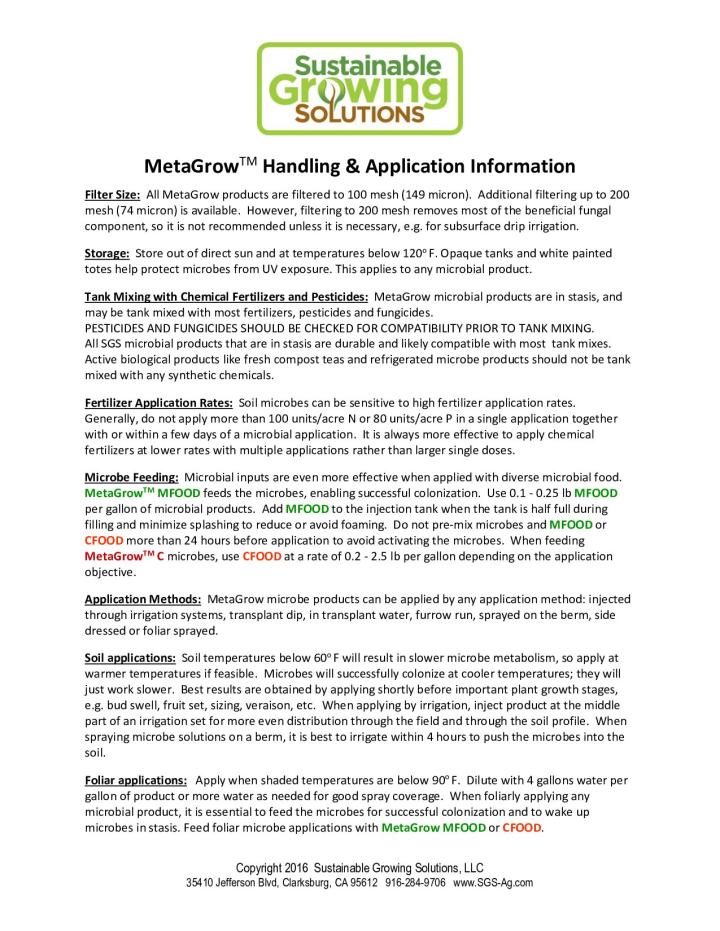
Microbe Handling and Application Info
This page is adapted from the SGS PDF “Microbe Handling and Application Info” (© 2016), which remains the technical reference. The 1-page original is available to download, print and share.
View the Technical PDF (PDF, opens in a new tab)