
Timing at a glance
When this applies
Any time MetaGrow is combined with fertilizers, microbe food, fungicides or pesticides in the same tank.
When to make the decision
Jar test 2 to 3 days before the production mix. Apply mixes containing microbe food within 8 hours, and fungicide or pesticide mixes within 24 hours (preferably less than 8).
What it’s designed to support
Microbes that stay protected in stasis until they reach the field.
MetaGrow microbes are durable
Microbes in stasis (all MetaGrow products) are protected from high temperatures (up to 120°F), freezing, high osmotic pressures, extreme pH, caustic materials and chemical toxicities. MetaGrow microbe products can be mixed with most ag chemicals while in stasis.
Actively respiring microbe products — those with a short shelf life or that require refrigeration — do not have protective coatings and suffer high mortality if mixed with synthetic fertilizers.
Microbes in stasis wake up
When food and habitat conditions are suitable, microbes in stasis wake up very quickly. If mixing microbes with microbe food or organic fertilizers, the mixture must be applied within 24 hours (preferably within 8 hours), as the microbes will wake up with exposure to food.
Synthetic fertilizer mixing
Synthetic fertilizers are typically not suitable habitat for microbes — they are too extreme in pH, caustic, high in osmotic pressure or toxic — so the microbes stay in their protective stasis.
Some successful fertilizer mixes tested at 50% concentrations include UN32, 8-4-10, 10-34-0 and K thiosulfate.
Jar test mixes first
Mirror the production mix
Use the same mixing order and concentrations as the intended production mix.
Seal it for 2 to 3 days
Let the mix sit in a sealed plastic bottle for 2 to 3 days at room temperature.
Check for swelling or odor
If the plastic bottle becomes swollen from off-gassing or has a bad smell, the test indicates the microbes woke up and are no longer stable.
Test viability
If the bottle is not swollen, do a further test to determine whether the microbes are still viable: dilute the mixture with water 10:1, feed with MFOOD™ or fish hydrolysate, stir and leave the top open.
Look under a microscope
After 24 hours, evaluate the microbes under a microscope. If the microbes are active, the mix is successful. If they are ruptured or inactive, they are incompatible.
Fungicides and pesticides
Most foliar-applied fungicides and pesticides (not systemic ones) have only minor effects on soil microbes. Do not tank mix more than 24 hours prior to application (preferably less than 8 hours).
MetaGrow tank-mix compatibility list
| Common name | Trade name | Compatibility |
|---|---|---|
| Azoxystrobin | Heritage, Quadris | OK |
| Banrot | Banrot | Avoid combination |
| Benodamil | Bayleton | Avoid combination |
| Benomyl | Benlate | Avoid combination |
| Boscalid, 3-pyridinecarboxamide, 2-chloro-N-(4'-chloro(1,1'biphenyl)-2-yl) | Endura | OK |
| Captan | Captan, Orthocide | Avoid combination |
| Carboxin + thiram | Vitavax | OK |
| Chloroneb | Terraneb SP, Terremec SP+B14 | Avoid combination |
| Chlorothalonil | Bravo Plus, Chloroflo, Chlortosip, Chloronil, Daconil 2787, Daconil Ultrex, Strike | OK |
| Chromobacterium subtsugae | Grandevo | OK |
| Copper hydroxide | Kocide | OK |
| Cydia pomonella granulovirus | CYD-X HP | OK |
| Cyproconazole | Sentinel | OK |
| Difenoconazole + metalaxyl | Dividend | OK |
| Dithiocarbamates | Ferbam | Avoid combination |
| Ethylenebisdithiocarbamate ion (EBDC) (C4H6N2S4) | Powerline MZ | OK |
| Etridiazole | Koban | Avoid combination |
| Fenaminosulf | Lesan | Avoid combination |
| Fenarimol | Rubigan | OK |
| Fenpropathrin | Danitol | OK |
| Fludioxonil, 70 - N-[3-(1-methylethoxy) phenyl]-2-(trifluoromethyl) benzamide | Maxim 4F, Maxim MZ | OK |
| Folpet | Phaltan, Cleary’s 3336, Fungo, Systec 1998, Senator WSB | Avoid combination |
| Fosetyl-AL | Alliette, Prodigy, Alliette Signature | OK |
| Hymexazol | Tachigaren | OK |
| Imazalil | Freshgard, Fungaflor, Nuzone | Avoid combination |
| Iprodione | Rovral, Chipco 26019 | OK for bacteria, not for Myco |
| Mancozeb (EBDC) | Manzate, Manzate flowable, Fore, Nubark MZ, Ridomil, Tops MZ, Tops MZ GAUCHO | Avoid combination |
| Maneb (EBDC) | Maneb, Mancozeb | Avoid combination |
| Metalaxyl-Ridomil | Apron / Subdue Maxx | OK |
| Myclobutanil | Eagle, Rally, Systhane | OK |
| Olpisan | Olpisan | Avoid combination |
| Oxyquinoleine | Carbostyril | Avoid combination |
| Pentchloronitrobenzene | Blocker | Avoid combination |
| Propamocarb | Banol, Previcur, Proplant | OK |
| Propiconazole | Stratego, Banner MAXX | Avoid combination |
| Pyraclostrobin | Headline | OK |
| Pyrethroid | Lambdastar, Delegate | Avoid combination |
| Quintozene | PCNB Terrachlor, Turfcide | Avoid combination |
| Spinosad | Entrust | OK |
| Tebuconazole | Folicur®, Folicur 3.6 | Avoid combination |
| Tebuconazole + metalaxyl | Raxil XT | Avoid combination |
| Tebuconazole + thiram | Raxil Thiram | Avoid combination |
| Thiazole | Benomyl, Benlate, Tersan 1991 | Avoid combination |
| Thiram | Thiram, Tersan 75 | Avoid combination |
| Triadimefon | Bayleton | Avoid combination |
| Triflumizole | — | Avoid combination |
| Zinc ethylene bisdithiocarbamate | Dithane | OK |
| Zinc white | Zinc oxide | Avoid combination |
| Ziram | Ziram | Avoid combination |
If you have questions regarding other chemical compatibilities, call SGS at (916) 284-9706 and we can figure it out.
Key takeaways
- MetaGrow microbes in stasis survive most ag chemical mixes; actively respiring microbe products do not.
- Never feed microbes before chemical mixing. Fed tank mixes with compatible chemicals should be applied within 8 hours.
- MetaGrow showed 95–100% survival in synthetic fertilizer mixes such as UN32, 8-4-10, 10-34-0 and K thiosulfate.
- Jar test every new mix for 2 to 3 days, then confirm viability under a microscope.
- Check the compatibility list — several common fungicides should not be combined with MetaGrow.
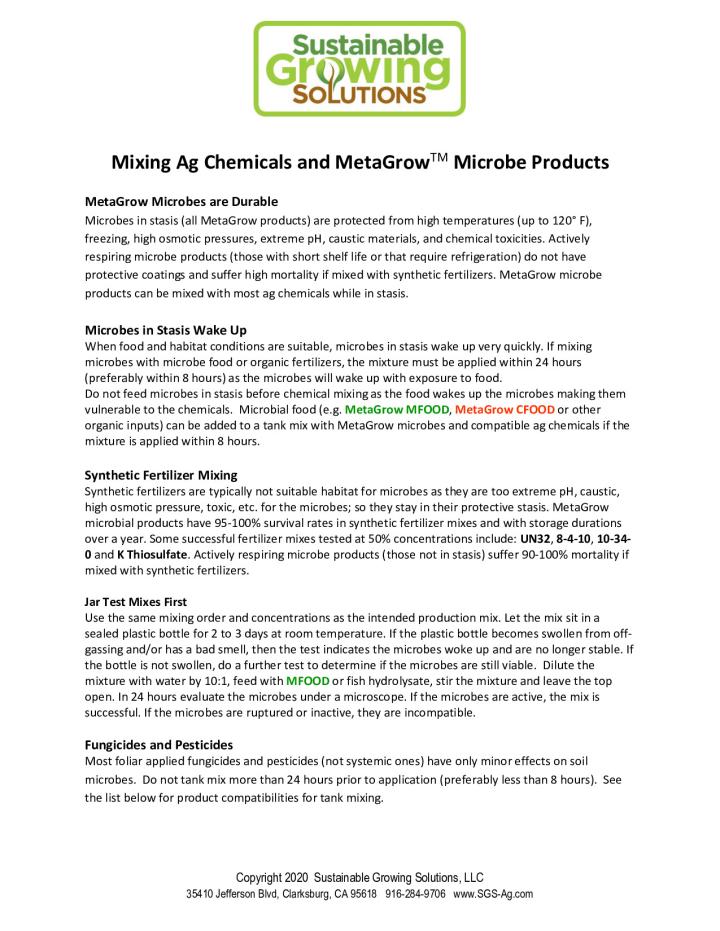
Ag Chemical Tank Mix Compatibilities
This page is adapted from the SGS PDF “Ag Chemical Tank Mix Compatibilities” (© 2020), which remains the technical reference. The 3-page original is available to download, print and share.
View the Technical PDF (PDF, opens in a new tab)