
The trial
- Location
- A vineyard near Sacramento, California
- Treatment
- MetaGrow ST at 2 gallons per acre and MetaGrow MFOOD at 0.5 lb per acre
- Applications
- One
- Sampling
- Two weeks after application, in the treated block and the adjacent control block
- Analysis
- Metagenomics: species composition, populations and functions
With just one application, after two weeks the results were impressive.
Results versus the control block
194%Increase in the number of microbe species
520%Increase in phosphate-solubilizing microbes
93%Reduction in plant pathogen composition
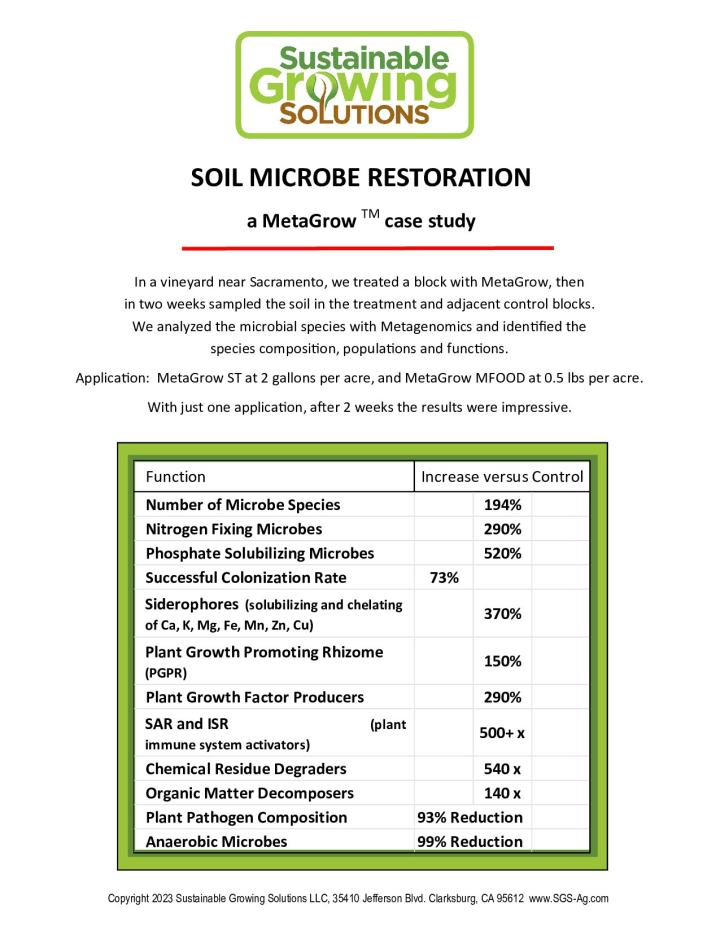
| Function | Increase versus control |
|---|---|
| Number of microbe species | 194% |
| Nitrogen-fixing microbes | 290% |
| Phosphate-solubilizing microbes | 520% |
| Successful colonization rate | 73% |
| Siderophores (solubilizing and chelating Ca, K, Mg, Fe, Mn, Zn, Cu) | 370% |
| Plant Growth Promoting Rhizome (PGPR) | 150% |
| Plant growth factor producers | 290% |
| SAR and ISR (plant immune system activators) | 500+ × |
| Chemical residue degraders | 540 × |
| Organic matter decomposers | 140 × |
| Plant pathogen composition | 93% reduction |
| Anaerobic microbes | 99% reduction |
Key takeaways
- One application — MetaGrow ST at 2 gal/acre with MetaGrow MFOOD at 0.5 lb/acre — was measured just two weeks later.
- The treated block showed a 194% increase in microbe species versus the adjacent control, with large gains in nitrogen-fixing (290%) and phosphate-solubilizing (520%) microbes.
- Plant pathogen composition fell 93% and anaerobic microbes fell 99%.
Original SGS resource
Soil Microbe Restoration Case Study
This page is adapted from the SGS PDF “Soil Microbe Restoration Case Study” (© 2023), which remains the technical reference. The 1-page original is available to download, print and share.
Download the Original PDF (PDF, opens in a new tab)